
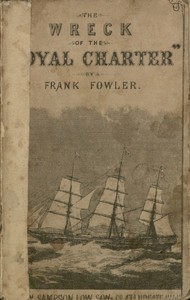
The Wreck of the "Royal Charter" by Frank Fowler
Frank Fowler’s account of the Royal Charter disaster is a piece of history that reads with the urgency of a novel. He pulls you right into the heart of the story, making a long-gone tragedy feel immediate and raw.
The Story
The book follows the final voyage of the Royal Charter, a state-of-the-art iron-hulled steamship. It’s 1859, and she’s racing home to Liverpool from Melbourne, her hold and her passengers’ pockets bulging with Australian gold. After a fast two-month journey, the ship is just hours from safe harbor in Anglesey, Wales. Then, a hurricane-force storm slams into the coast. Fowler lays out the terrifying sequence: the ship drops anchor to ride it out, but the chains snap. Driven onto the rocks, the Royal Charter is battered apart within sight of land. The narrative doesn’t shy away from the chaos and horror of that night—the desperate attempts to get a line to shore, the tragic fate of many who tried to swim for it weighed down by gold, and the heroic efforts of local villagers who risked their own lives to save others.
Why You Should Read It
What makes this book stick with you isn’t just the scale of the wreck, but the human details Fowler captures. It’s in the quiet moment a passenger writes a last letter home, and in the frantic calculations of the captain knowing his ship is doomed. Fowler, writing shortly after the event, channels the public shock and grief. He makes you feel the irony of a journey ended so catastrophically at its very finish line. The book is also a fascinating look at 19th-century technology and society—this ship was the height of modern travel, yet it was utterly helpless against the storm. It’s a powerful reminder that our confidence can be shattered in an instant.
Final Verdict
This is a must-read for anyone who loves true-life adventure stories or maritime history. It’s perfect for fans of books like In the Heart of the Sea. Fowler’s writing is direct and vivid, without getting bogged down in overly technical language. You come away feeling like you’ve witnessed a key moment in history—one that, as the afterword often notes, actually did lead to better storm warning systems. It’s a tragic, gripping, and ultimately respectful tribute to the hundreds of lives lost on that awful night.
This historical work is free of copyright protections. Knowledge should be free and accessible.
Margaret White
1 year agoUsed this for my thesis, incredibly useful.
Thomas White
1 year agoFinally found time to read this!
Donna Flores
7 months agoThis is one of those stories where it manages to explain difficult concepts in plain English. I learned so much from this.
Sarah Flores
1 year agoVery interesting perspective.





David Lewis
1 year agoThe layout is very easy on the eyes.