
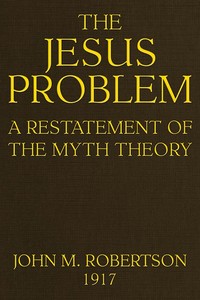
The Jesus Problem: A Restatement of the Myth Theory by J. M. Robertson
Let's get this out of the way: 'The Jesus Problem' is not a novel. There's no plot in the traditional sense. Instead, the 'story' here is the story of an argument. J.M. Robertson, a Scottish journalist and politician writing in the early 1900s, lays out a detailed case for what's called the 'Christ myth theory.'
The Story
Robertson's core idea is that the figure of Jesus Christ as presented in the Gospels is not based on a single historical person. Instead, he argues the character is a composite—a myth built from older religious stories and ideas that were floating around the ancient Mediterranean and Near East. He spends the book comparing elements of the Jesus story—the virgin birth, the miracles, the death and resurrection—to similar motifs in pagan cults, Jewish wisdom traditions, and pre-Christian 'dying-and-rising god' figures like Osiris or Attis. His goal is to show that you don't need a historical Jesus to explain where the Christian narrative came from; it could have evolved naturally from these existing myths.
Why You Should Read It
You should read this not for easy answers, but for the intellectual workout. Robertson's writing is dense and his evidence is piled high. Reading it feels like watching a meticulous lawyer build a case, piece by piece, from ancient texts. It's fascinating to see how ideas we think of as uniquely Christian have parallels that predate Bethlehem. This book isn't about faith or spirituality; it's a cold, historical analysis. It forces you to separate the 'Jesus of faith' from the 'Jesus of history' in the most radical way possible—by questioning if the latter existed at all in any meaningful way. Whether you agree with his conclusion or not, it makes you realize how much of history is interpretation.
Final Verdict
This book is for a very specific reader: the patient skeptic, the history nerd who loves primary sources, or anyone deeply interested in the roots of religion and how stories are made. It's not for someone looking for a light introduction to biblical criticism—it's old, academic, and can be a slog. But if you want to understand one of the most controversial arguments about Christian origins straight from one of its early architects, this is essential, challenging reading. Just be ready to have your historical assumptions put through the wringer.
This digital edition is based on a public domain text. You do not need permission to reproduce this work.
Jessica Harris
10 months agoHaving followed this topic for years, I can say that the footnotes provide extra depth for those who want to dig deeper. I feel much more confident in my knowledge after finishing this.
Karen Gonzalez
11 months agoI was skeptical at first, but the plot twists are genuinely surprising. Definitely a 5-star read.
Lisa Smith
9 months agoClear and concise.
Logan Jackson
11 months agoRead this on my tablet, looks great.



James Martin
5 months agoThe clarity of the introduction set high expectations, and the way it challenges the status quo is both daring and well-supported. This adds significant depth to my understanding of the field.